Private Micro-Reserves in Romania (MPR)®
Private Micro-Reserves in Romania (MPR)® & River Contracts (Contrats de Rivière)
INNOVATIVE SYSTEM OF PROTECTION & PRIVATE LAW
The first national model of voluntary ecological stewardship on private land, integrated with river basin stewardship inspired by the French Contrats de Rivière. Coordinated by the Aquaterra Ecological Society and operated together with the Young Rangers to protect our nature, soil, and waters.
🌲 How It All Started: A Personal Story Spanning Over 50 Years
🌱 In the roots of childhood (Plutonița, 1970)
The concept of the Private Micro-Reserve was not born in an office, but has its origins in my childhood, over 55 years ago. When I was just 10 years old, growing up on the outskirts of Plutonița village at the foot of Mount Ghirleu, I had before my eyes the living example of one of the most beautiful virgin forests in Romania: the Slătioara Secular Forest.
My relatives (the Tăutu and Măzăre families) served as foresters, guards, and rangers there ever since the reserve was established in 1928 by our great naturalists (Emil Racoviță, Alexandru Borza, Grigore Antipa, Ion Borcea). Respect for nature was planted in my heart directly by my family.
Behind our house in Plutonița lay a small forest where trees were logged, animals grazed, and hunting took place. Even though I was only a few years old, I saw daily through the orchard hares, martens, hedgehogs, foxes, squirrels, as well as wolves or bears coming down from the mountain. Between the ages of 4 and 10, I conducted a long effort of persuasion with my grandfather and uncle, the owners of that land. I asked them to leave that small woodland and its meadow to me, so we could declare it — tacitly, within our extended family — a protected reserve, where no more trees would be cut and no more livestock would graze.
📜 The Founding Document of July 31, 1983
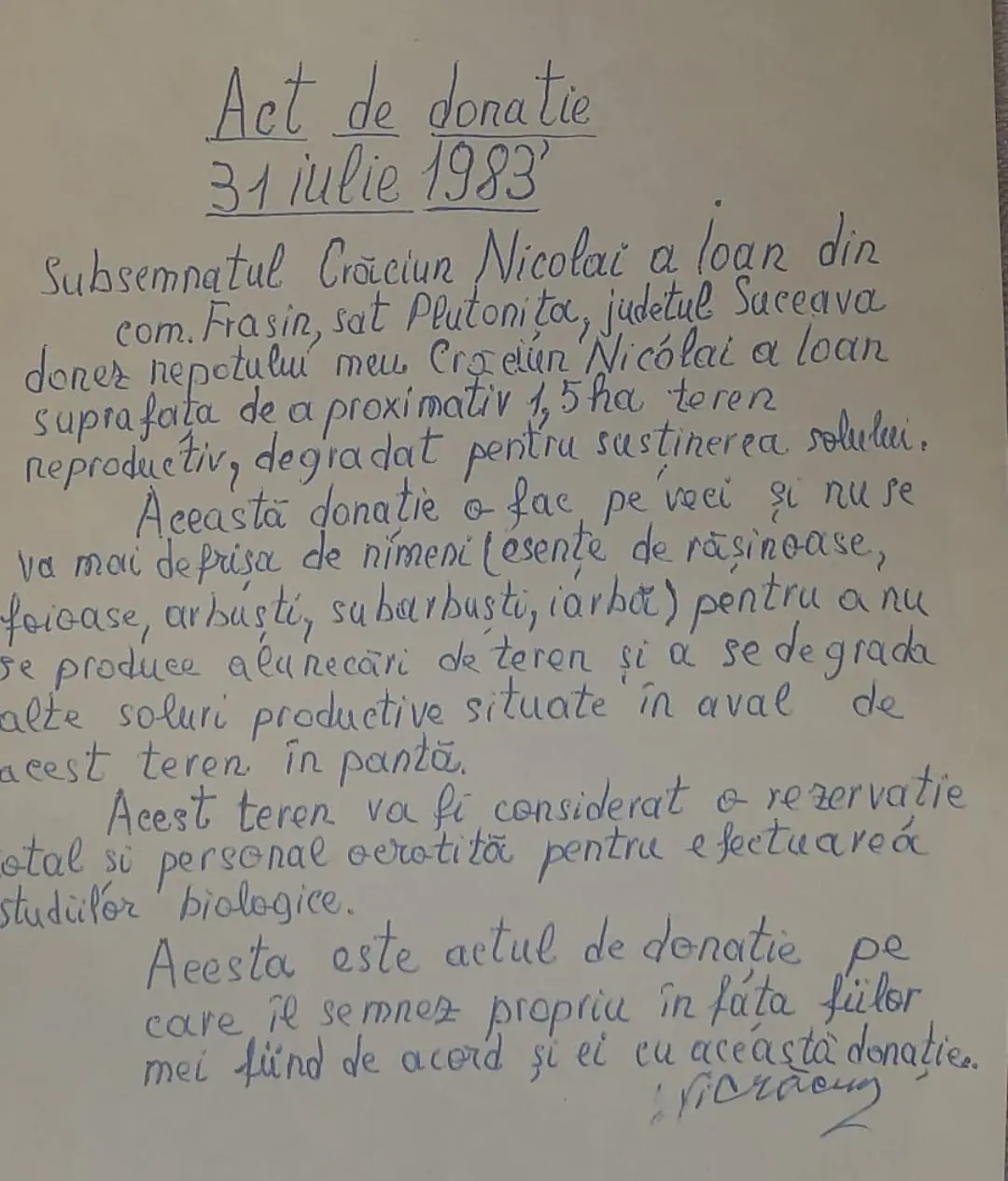
The original deed of donation through which my grandfather, Nicolai Crăciun a Ioan, enshrined the protection of the land in Plutonița.
Deed of Donation
July 31, 1983I, the undersigned Crăciun Nicolai a Ioan, from Frasin commune, Plutonița village, Suceava county, donate to my grandson Crăciun Nicolai a Ioan an area of approximately 1.5 hectares of non-productive, degraded land intended for soil stabilization.
I make this donation for all eternity, and the land shall never be cleared by anyone (conifers, hardwoods, shrubs, subshrubs, grass) in order to prevent landslides and the degradation of other productive soils located downstream from this sloped land.
This land shall be considered a fully and personally protected reserve for conducting biological studies.
This is the deed of donation which I sign in person before my sons, who also agree to this donation.(ss) Crăciun
In 1983, my grandfather formalized this request through a visionary deed of donation, writing with his own hand the priceless clause: "the land shall never again be cleared by anyone for all eternity... to prevent landslides, being considered a fully and personally protected reserve for conducting biological studies."
During my student years (1986) and again after 1990, I attempted the official registration of this micro-reserve with the Commission for the Protection of Natural Monuments under the Romanian Academy. However, I discovered that the legislative framework in Romania focused exclusively on public protected areas. Thus was born the idea that we needed to create a modern model — 100% private, autonomous, and voluntary — adapted to a democratic society.
🌍 Why Is Change Urgent in Romania?
Only 29% of Romania's surface is covered by forests, well below the European average, even though one-third of the country is represented by the Carpathian Mountains. Forest cover ought to increase substantially to reach the European average of around 40%, which would ensure the rebalancing of Romania's climate — a climate that has turned excessively temperate, with rapid desertification trends, especially over the last 45–50 years.
What the Ministry of Education does in this regard is very little. What the Ministry of Environment and Climate Change does through its administrative policies across all Romanian localities bears a striking resemblance to the activities in this field of ill-remembered former state institutions, rather than demonstrating a open embrace of a democratic society.
🏛️ The MPR Vision and the Young Rangers Clubs
We embark on our endeavor with the vision of establishing Private Micro-Reserves in Romania as a concept, but we also propose the creation of Young Rangers Clubs in primary and secondary schools across Romania, rooted in the core ideals of love and devotion toward nature and care for its fragility. We aim to shape living, responsible consciences toward nature, instilling active feelings in the hearts of these children, in whom the sacred feeling of love for nature will grow from early childhood.
These children will become active, responsible agents of change once they reach adulthood, serving as beneficial drivers in transforming both nature and Romanian society for the better. We base this strategy on the equal participation of children, their spiritual mentors who will monitor and help them, and their biology teachers, who will embrace the Aquaterra Ecological Society's concept of private micro-reserves and Young Rangers Clubs.
All of this will change mindsets across communities: first in schools, then within their families, inspiring children to persuade their parents not to cut down their forests — as these represent their very future — but to transform them into children's micro-reserves.
Any middle school child aged between 10 and 14 has a life horizon of 60–70 years, something their parents, and especially their grandparents, no longer have. This Micro-Reserves concept is also based on the principle that children will own micro-reserves and watch them become Oases of vegetation and biodiversity surrounded by degrading land, with the former serving as safe havens for flora and fauna. It goes without saying that a private ranger can perform conservation work with 100% dedication on a natural area that is their own property, unlike someone performing this work on public land, state-protected areas, or as a public servant of an environmental agency with duties rarely fulfilled in full at administrative and active conservation levels in Romania.
We highlight that our goal carries this major advantage of training private rangers, as well as future biologists for biodiversity conservation and sustainable development in the Romania of today, of tomorrow, and certainly for the next 70 years!
🎓 A Shift in Educational Direction: The Bioedu Program
WE ARE TRIGGERING A PROFOUND, DIRECTION-SHIFTING EDUCATIONAL PROCESS!
We are training tomorrow's generation of environmental activists in Romania! We are also preparing future academic specialists, as many of these children will be guided by us toward university-level biological education to become tomorrow's zoologists, botanists, ecologists, oceanographers, and experts in conserving Romania's biodiversity.
At the core of our educational concepts lies another principle unique to biological education: if you awaken in children as early as possible — from ages 7 to 14 — the sacred understanding of nature and the role of an educated, responsible human as a good conductor of nature, those children will remain passionate about nature for the rest of their lives. Upon reaching adulthood, the majority will wish to become responsible naturalists and members of the scientific and academic community, carrying their passion forward throughout their lives.
These children will become tomorrow's leaders in Romania, and through the Young Rangers and Bioedu programs, we will prepare them for this future of theirs and of Romania.
Other children, who choose professions outside the natural sciences, will be able to become lifelong rangers as a secondary calling. Throughout their lives, they will be able to manage their wild forest and meadow properties ecologically, organize eco-farms, and establish select, profitable tourism ventures in eco-tourism, ecological agro-tourism, and the Blue Economy. All of them will consider themselves useful to society and nature as active, profound transformational drivers across all social spheres in Romanian society — just as Western societies have done for over 40–50 years, having been free for over 200 years and long democratized, which was not historically the case for Romania.
🏛️ Operational Vision & International Examples
How the MPR Team Operates in Three Simple Steps:
- The Landowner: Contributes their land while remaining its full owner, choosing to protect it.
- S.E. Aquaterra: Provides scientific expertise, conducts ecological assessments on-site, and ensures everything is properly protected.
- Community Partners & Companies (CSR/ESG): Help us cover expenses for equipment, security, and field studies.
🌊 River Contracts: The French Model (Contrats de Rivière)
Inspired by the pioneering and highly successful model created in France, River Contracts (Contrats de Rivière) serve as voluntary, participatory agreements between riparian landowners, local communities, water authorities, and environmental experts. Through this framework:
- Watershed Stewardship: Streams and rivers flowing through or adjacent to Private Micro-Reserves are protected from pollution, bank deforestation, and invasive civil engineering.
- Ecological Corridors: Riparian zones are transformed into thriving biodiversity corridors, connecting fragmented forest ecosystems with healthy aquatic habitats.
- Shared Local Responsibility: Landowners, schools, and young rangers participate directly in monitoring water quality and restoring natural riverbanks.
🌍 How Others Succeed Around the World
Protecting nature on private land is not a new idea — it has worked for decades in other countries and has saved entire communities:
- France (Contrats de Rivière): Pioneered multi-stakeholder voluntary agreements at the river basin scale, uniting local municipalities, landowners, and citizens to protect river ecosystems and water quality.
- USA (Land Trusts): Owners of forests or grasslands voluntarily choose not to allow paved development or destruction on their land. In return, an NGO cares for nature, and the state offers tax exemptions. Millions of hectares of pristine nature have been saved this way without the state spending a single dollar.
- Chile: Instead of leaving land open to wild exploitation, visionary individuals bought large forest tracts and turned them into private reserves. In doing so, they attracted tourists from all over the world, while local youth gained jobs as guides and nature protectors.
- South Africa: There are over 9,000 private game and nature reserves where owners ensure wildlife is guarded against poachers. This is proof that protected nature can bring prosperity to an entire region.
- Australia (Landcare): Farmers and neighbors in a region came together into land stewardship groups. They care for rivers and soils together, recognizing that healthy nature means a more prosperous farm.
⚖️ Legal Framework and Property Rights
Romania's legal framework provides a solid foundation for establishing and protecting Private Micro-Reserves while fully respecting guaranteed property rights and free ecological initiative:
- Constitution of Romania (Art. 44) & The New Civil Code (Art. 555): Private property rights are guaranteed. The landowner holds the absolute right to use, transfer, or establish voluntary environmental easements on their land.
- Forestry Code (Law no. 46/2008): Allows private forest owners to opt for special protection measures, forestry non-intervention, and biodiversity conservation through dedicated custody agreements.
- GEO no. 57/2007 on the regime of protected natural areas: Encourages private conservation initiatives outside the public network, enabling environmental associations and private owners to establish partnerships for ecological land management.
🚀 Long-Term Commitment and Paternity Rights
The unique program we are launching begins this year and spans 10 years in its first phase.
After the first set of micro-reserves is established as initiatives under the umbrella of S.E. Aquaterra, we will concurrently propose a series of laws favoring the future development of this new type of protected area — 100% private — which will build their own autonomous organizational structure and future development strategies across our entire country, from the peaks of the Carpathian Mountains to the Black Sea.
Furthermore, as originators of this new type of protected natural area and the new type of ranger over their own created private reserves (which did not previously exist as an original concept), we reserve the right of paternity over these concepts initiated by the president and members of S.E. Aquaterra. These stem from the central station/location from which the project will expand — from Noah's Little Ark (founded by the Aquaterra Ecological Society starting in 2006 in Plutonița village, Frasin town, Suceava County, ROMANIA) — as well as from the headquarters located within the Faculty of Biology at the University of Bucharest.
President of S.E. Aquaterra,
Lect. Univ. Dr. Nicolai Crăciun