General Overview: „Noah’s Little Ark” Research Station
Biotechnological and Engineering Conservation Infrastructure at Plutonita
Structural guide of the fisheries and forestry research station:
- SECTOR I: Interactive Visualization & Digital Mapping
- SECTOR II: Greenhouse-Type Facility Complex (S1, S2, S3, SA)
- SECTOR III: Outdoor Tank & Live Food Infrastructure (B1-B6, HV1)
- SECTOR IV: Logistics, Support Units, and Mountain Spring Water Intakes
SEAquaterra Research Station Infrastructure - Plutonita
The Plutonita Research Station (Suceava County), dubbed „Noah’s Little Ark”, represents the operational core for ex-situ conservation of the AQUATERRA Ecological Society. Located in an ideal mountain biotope at GPS-WGS84 coordinates 47°28'55.45"N 25°47'8.44"E, the facility is specially designed for advanced research in ichthyology, eco-ethology, fish genetics, and forest management.
All station activities are carried out on private infrastructure provided under a non-commercial bailment agreement (comodat), serving as a practical training and mentorship platform for students and researchers from the Faculty of Biology, University of Bucharest.
Documentary: Presentation of Sturgeon Breeding and Rearing Tanks
Before exploring the cartographic details of the station, we invite you to watch a video insight into the sector dedicated to rare sturgeon species intended for restocking (biotechnological stage, feeding, and dynamics of these freshwater giants in the indoor tanks):
🗺️ Sector I: Interactive Exploration and Digital Mapping
🎯 Biotechnological Hotspots
To avoid lag or partial map loading inside the page, we have developed an optimized full-screen version.
Use the button below to open the digital interactive map in a new tab and explore the more than 20 conservation hotspots:
📐 Technical Blueprint and Hydrodynamic Vectors
The general layout below highlights the spatial distribution of the aquaculture facilities, sorting areas, reinforced concrete platforms, and the routes of the main mountain spring water alignment pipelines:
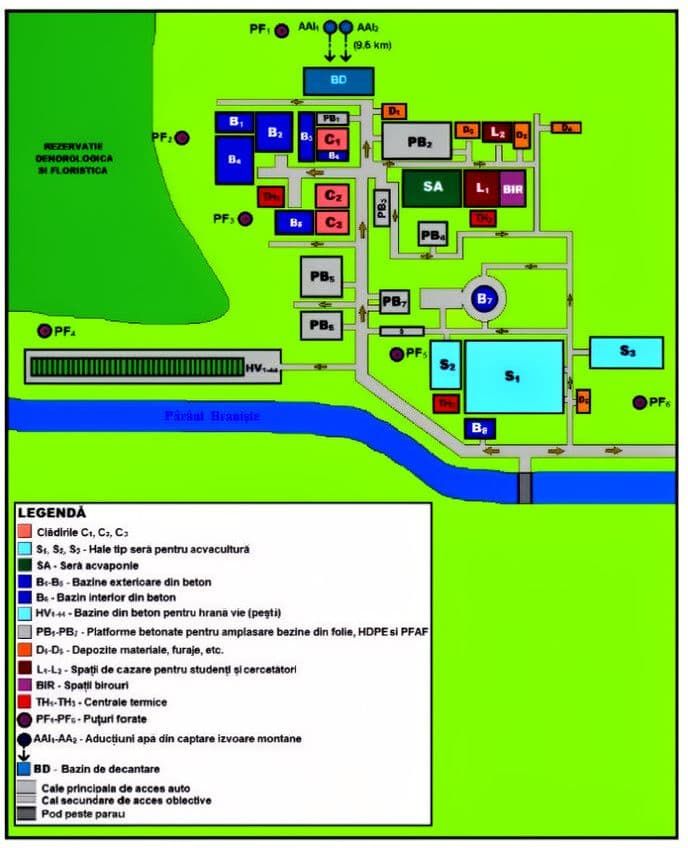
*Graphic source: Hydraulic architecture technical archive of the SEAquaterra Station (Plutonita Branch).
🏢 Sector II: Greenhouse-Type Facility Complex for Aquaculture and Aquaponics
Indoor systems are optimized for controlled breeding and protection of sensitive genetic stocks during extreme temperature periods.
🧪 Direct RAS Facilities (S1, S2, S3)
- Biological Purpose: Housing Recirculating Aquaculture Systems (RAS) intended for Zug-Weiss type incubators, microbiological troughs for larvae starting, and linear raceway tanks.
- Sustainability: Each facility features an eco-friendly thermal management system based on dedicated heating units (TH1-TH3) and automated systems for monitoring dissolved oxygen, pH, and ammonia.
🌿 Experimental Aquaponics Greenhouse (SA)
- Circular Bio-Filtration System: This module integrates fish production with plant production. Wastewater from the culture facilities, loaded with residual nitrogen compounds, is directed to the aquaponic beds.
- Result: Plants completely extract these nutrients as a natural fertilizer, biologically purifying the water. It is subsequently recirculated back into the tanks, achieving an effluent with zero impact on the local hydrographic network.
Technical Documentary: Multi-Tiered Greenhouse and Experimental Laboratory
Watch the detailed scientific explanations regarding the implementation of the closed-loop bio-filtration system inspired by NASA ecological models, utilizing sponges, freshwater clams, snails, and microphytes for sustainable purification:
Sector III: Technical Matrix of Outdoor Tanks and Live Food Units
The outdoor concrete infrastructure and attached structures ensure the water volumes required for maintaining broodstock lots and acclimating fry before release into the wild:
| Facility Code | Name and Technical Specifications | Estimated Volume / Structure Type | Ecological Function & Current Status |
|---|---|---|---|
| B1 | Main outdoor concrete tank for hucho. | ~ 90 m³ / Massive reinforced structure | Acclimatization and Stocking: Intended for large Danube salmon (Hucho hucho) specimens. Status: 70% completed at the tank basin level. |
| B2, B3, B4 | Secondary outdoor concrete cascade tanks. | 45 m³ each / Gravitational flow | Fry Rearing Lots: Allows sorting by size classes to prevent cannibalism. Currently under finishing works. |
| B5 | Outdoor retention and thermal stabilization tank. | ~ 60 m³ / Flow control | Water Buffer: Balancing the temperature of spring water before it enters the RAS units. Completed. |
| B6 | Special indoor concrete tank. | Located in the protected technical zone | Quarantine and Treatments: Isolation of new ichthyological lots and application of ecological phytotherapy. Operational. |
| HV1 - HV4 | Concrete tanks for auxiliary bio-cultures. | Shallow compartmentalized units | Live Food Production: Experimental cultivation of crustaceans, invertebrates, and aquatic organisms for larvae. |
| PB1 - PB7 | Utility reinforced concrete platforms. | Poured support for flexible systems | Modular Extensibility: Intended for rapid installation of mobile tanks made of liner, HDPE, and PFAF structures. |
Sector IV: Logistics, Support Units, and Mountain Spring Water Intakes
The long-term sustainability of the station is guaranteed by logistic units and an independent supply network providing water of exceptional ichthyological purity:
Main Building, Research and Education Spaces
- Central Building (Laboratories & Conferences): An extended structure housing smooth-plastered, tiled laboratories on the ground floor dedicated to microscopic analysis, auxiliary cultures, and biosecurity, and a beautiful panoramic conference room on the first floor, open to the Bucovina forest landscape.
- „Junior Rangers” Club: Space dedicated to alternative education programs, mentorship camps, and training young people who want to understand nature protection directly in the field.
- L1 - L2 (Accommodation Spaces): Modules dedicated to hosting undergraduate, master's students, and researchers during internships or long-term ecological monitoring campaigns.
- BIR (Office Spaces): Administrative field center, equipped with communication gear and experimental data storage units.
- D1 - D5 (Material and Feed Storage): Secured and climate-controlled spaces for storing specialized ichthyological feed and field equipment (waders, nets, probes).
Hydraulic Safety and Supply System
- PF - Drilled Wells: Hydrogeological deep sources used as a critical safety backup in case of extreme drought or freezing at surface water intakes.
- AA1 - AA2 (Mountain Spring Water Intakes): Complex water pipelines that gravitationally bring clean water over a distance of up to 5 km from the heart of the mountains, ensuring an optimal, stable, and well-oxygenated flow.
- BD (Settling Tank): Technical unit for primary gravitational mechanical filtration. It ensures the elimination of suspended solids and water turbidity after torrential rains.
Video Gallery: Architectural and Logistic Presentation of Sector IV
Video 1: Building Structure and General Station Logistics
Video 2: Water Supply System and Outdoor Ponds Under Construction
Video 3: Interior of the Main Building (Laboratories, Conference Room, and Junior Rangers Club)
Academic Status and Institutes of the Plutonita Branch
The AQUATERRA Ecological Society is a professional, non-governmental, and non-profit biodiversity conservation association founded in 1993 (CUI: 8046291). The organization is formally accredited by the Ministry of Education and Research as a scientific research and environmental consulting expertise unit, acting directly under international mandates for the implementation of UN conventions and European Union directives.
Within the Plutonita Station („Noah’s Little Ark”), scientific activity is structured around three major institutional pillars:
- Research Center for the Breeding and Restocking of Rare and Endangered Fish Species of the Romanian Ichthyofauna: Core unit focused on developing the biotechnological base for saving mountain ichthyological pillars.
- Breeding, Rearing and Restocking Station for Danube Salmon (Hucho hucho): Unit specialized exclusively in genetic management, biosecurity, and controlled multiplication of the largest salmonid in our waters.
- Research Center for Forestry, Forest Ecology, Geography and Biogeography: Interdisciplinary department dedicated to monitoring hydrographic basin quality, micro-climatic impacts, and forest landscape ecology in Bucovina.
Elite International Affiliation
The association is an active member or partner in world-prestigious organizations:
- Sustainable Romania Coalition
- EUROFISH International Organisation
- Natura 2000 Network
- Official representative in Romania of the World Fish Migration Foundation
Resources and Institutional Transparency
- Download AQUATERRA 2026 Standard Presentation (PDF - Google Drive)
- Consult the Updated Official Bylaws (PDF - Google Drive)