Pillar 2: Ex-Situ Conservation, Bio-Bases and Artificial Breeding Technologies
🧪 Ecological Technologies and Preservation of the Fish Genetic Heritage
Strategic directions for bio-base development and restocking:
- 📌 DIRECTION 1: Recirculating Infrastructure and Bio-Base Management (Plutonița)
- 📌 DIRECTION 2: Non-Commercial Artificial Breeding Protocols
- 📌 DIRECTION 3: Ecological Treatments and Prophylaxis using Marine Plant Extracts
- 📌 DIRECTION 4: Restocking Programs and Post-Acclimatization Monitoring
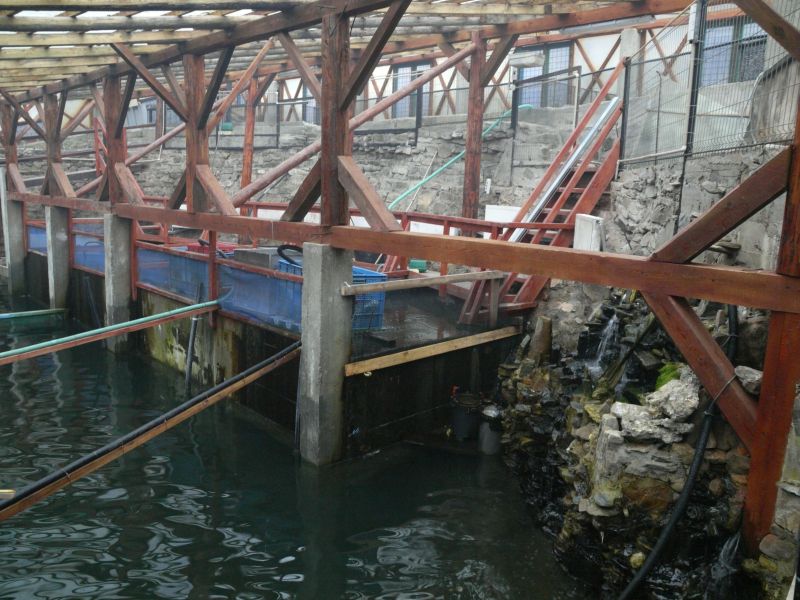
Credit: SEAquaterra Research Station - Plutonița
Ecological Engineering and Ex-Situ Conservation of the Fish Genofond
🔍 Why is Ex-Situ Conservation Critical?
When natural habitats are severely fragmented by dams or affected by pollution, simple in-situ protection (in nature) is no longer sufficient for the survival of critical species. SEAquaterra develops and implements advanced ex-situ conservation solutions in dedicated bio-bases. The objective is not commercial aquaculture, but maintaining pure genetic lines and producing vigorous ichthyological material for ecological restoration programs.
🦺 DIRECTION 1: Infrastructure of Recirculating Aquaculture Systems (RAS) at Plutonița Station
Description: Designing, optimizing, and operating recirculating aquatic systems for the controlled monitoring of water physical-chemical parameters. Adapting the technology to the eco-ethological requirements of mountain species.
👉 For technical visits or details regarding the infrastructure in Suceava county, contact us at office@seaquaterra.org.
🧬 DIRECTION 2: Standardization of Breeding Protocols for Endangered Species
Description: Elaborating technical guidelines to induce ovulation and spermiation using non-invasive or low-stress methods. Preserving genetic variability within captive-bred fish populations.
👉 Breeding protocol summaries can be requested via the form at the bottom.
🌿 DIRECTION 3: Utilizing Marine Plant Extracts in Ichthyological Prophylaxis
Description: Advanced research into the use of phytotherapy and bioactive compounds extracted from marine plants for the ecological disinfection of eggs and the treatment of mycoses, eliminating synthetic chemicals with residual impact.
👉 Patent or article summaries on this topic are available upon request.
🚚 DIRECTION 4: Management of Restocking and Acclimatization Programs
Description: Establishing methodologies for stress-free transport, pre-acclimatization in buffer tanks, and the controlled release of fingerlings into natural fish habitats. Success evaluation through marking techniques.
👉 For partnerships with angling associations or protected area custodians, please use the official email address.
🔬 Original Research Directions from the Doctoral Thesis
Graphic and conceptual capitalization of applied fish eco-ethology studies at Plutonița:
🐟 1. Ecophysiological Optimization of Artificial Breeding in Hucho hucho (Danube Salmon)
Advanced biosecurity technologies and broodstock flock management under Plutonița Station conditions.
🐠 2. Ex-Situ Conservation and Rescue Strategies for Romanichthys isfanensis (Asprete)
Critical microhabitat analysis and adaptation protocols to controlled conditions for the rarest fish in Europe.
🦈 3. Eco-Ethological Dynamics and Experimental Restocking with River Sturgeons (Acipenseridae)
Migration behavior monitoring and evaluation of successful integration into natural hydrographic basins.
📊 Research Matrix and International Connectivity
| Species 🐟 | Research Direction (PhD) | Similar Studies / Web References | Application Status (Plutonița Station) |
|---|---|---|---|
| Danube Salmon (Hucho hucho) | Nutrition protocols and optimization of seminal material quality in captivity. | IUCN Hucho Conservation / Danube Studies (Austria) | Ongoing: Monitoring ecophysiological parameters in controlled tanks. |
| Asprete (Romanichthys isfanensis) | Absolute ex-situ conservation. Recreating rheophilic microstructure (fast current) and live feeding. | No external applied studies available. | 🔥 SEAquaterra Original Research: Unique pilot project to save the species from extinction. |
| Sturgeons (Acipenseridae) | Eco-ethological assessment of artificially bred fingerlings before and after release into rheophilic environments. | World Sturgeon Conservation Society / LIFE-Sturgeon Projects | Ongoing: Tagging technologies and pre-adaptation to Danube stream currents. |
📚 Academic Structure of the Doctoral Thesis
Academic documentary source: Structural excerpt from the work "Research on Comparative Ethology of Certain Marine and Freshwater Fish from Romanian Fauna" – Author: Biol. Nicolai Crăciun. Scientific Supervisor: Dr. doc. Petru Bănărescu, corresponding member of the Romanian Academy.
📑 PART I: Theoretical Considerations and History of Ethological Research
- Chapter 1: History and development of ethology as an independent biological science. Fundamental concepts emitted by Heinroth, Konrad Lorenz, Tinbergen, and von Frisch.
- Chapter 2: Schools and orientations in animal behavior research. Comparative analysis between European classical ethology (objective, based on natural environment observation) and American reflexology/behaviorism.
- Chapter 3: The relationship between philosophical currents and ethology. Holistic approach, organicism (Smuts, von Bertalanffy, Woodger) and the rejection of reductionist mechanism in favor of dynamic organism-environment integration.
📑 PART II: Original Eco-Ethological Research on Fish Models
- Chapter 4: Methodology of comparative ethological research in fish. Direct observation techniques, video recording, and experimental tank design for simulating rheophilic biotopes.
- Chapter 5: Breeding ethology and territorial behavior in Danube Salmon (Hucho hucho). Intersexual stimulation mechanisms and environmental parameters optimization at Plutonița bio-base.
- Chapter 6: Critical microhabitat analysis and ex-situ strategies for Asprete (Romanichthys isfanensis). Ethological study of nocturnal and sheltering behavior under the influence of water stream dynamics.
(Current notice: The fundamental ethological data from this chapter serve as scientific support; currently, applied on-field rescue projects are autonomously developed by the Alex Găvan Foundation within the official campaign Aspretele Trăiește, the thesis author, Biol. Nicolai Crăciun, providing exclusively senior ichthyological specialty consultancy, not executive collaboration).
📑 PART III: Evolutionary Synthesis and Applications in Ecological Engineering
- Chapter 7: Communication and interspecific social behavior in aquatic biocenoses. Supra-individual integration levels and manifestation of natural selection.
- Chapter 8: Ethological structure of migrations in rheophilic species and sturgeons. Orientation mechanisms and behavioral maps along the Danube and its tributaries.
- Chapter 9: Capitalizing on results in ex-situ conservation and sustainable genofond management. National rescue protocol applied within SEAquaterra installations.
Figure 3: Original ethological sketch adapted from the graphical annex of the thesis. Theoretical representation of hydrodynamic vectors and the angle of rheotactic orientation (α) experimentally determined in continuous flow for fingerlings of rheophilic species and river sturgeons.
📚 Additional Resources and Reference Documents
In accordance with academic standards and intellectual property protection, the Ex-Situ Conservation Technical Guides, applied studies on RAS systems, and the Doctoral Thesis (Prof. Dr. Nicolae Crăciun) are issued in full digital format exclusively upon request.
If you are developing a research project, an academic paper, or a feasibility study for ecological reconstruction, please use the contact form on the main page or send us an official request at:
👉 office@seaquaterra.org
(Please specify your institutional affiliation and the title of the project where the data will be integrated).