Exploration & Science: The Comana Chub (Petroleuciscus celensis)
📌 The Explorer's Journal: The Birth Certificate of the Comana Chub
Field Journal — An epic expedition and the behind-the-scenes of a major discovery (April 5, 1995)
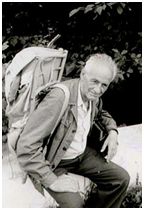 Acad. Petru Bănărescu, Romania's greatest ichthyologist, fully equipped for the field.
This photograph captures an important scientific discussion between myself, my students — young ichthyologists in training and active AQUATERRA members, then in their 3rd year at the Faculty of Biology — and Academician Petru Bănărescu. It was the scientific birth certificate of a new species, where I am proud to say I am a co-author alongside Romania's leading ichthyologists: Petru M. Bănărescu and Teodor Nalbant.
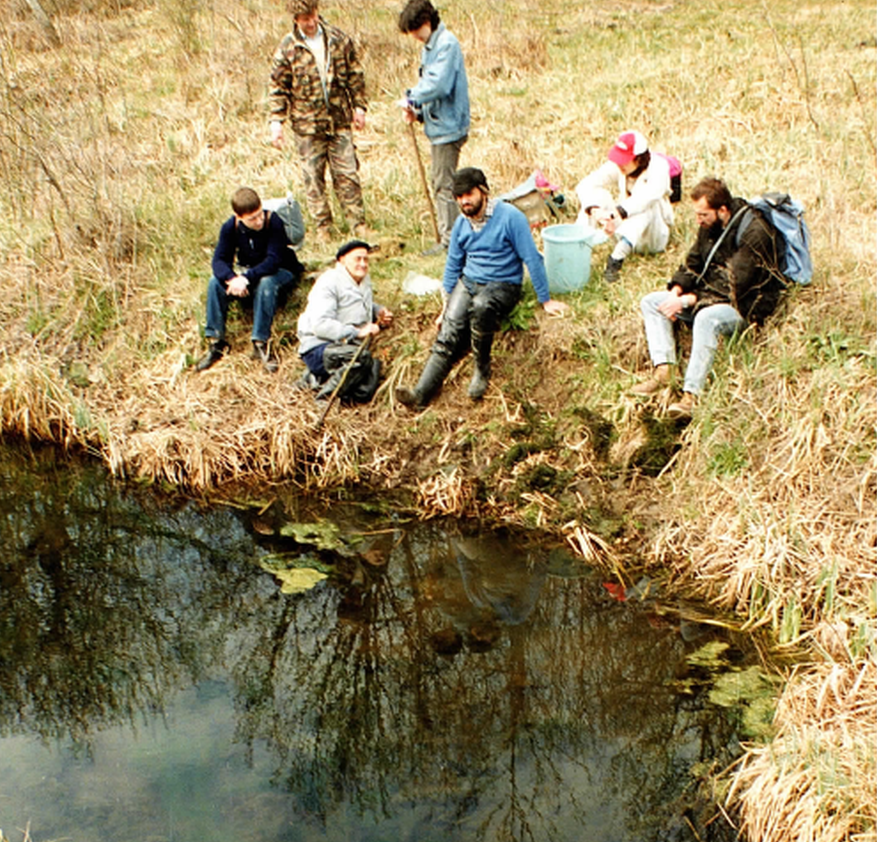 On the banks of the Valea Gurbanului stream with Acad. Petru Bănărescu, Adrian Ionașcu, Ionuț Cristea et al. (Comana, April 5, 1995, Aquaterra photo archive).
The picture with Mr. Bănărescu and my students at the time, Adrian Ionașcu and Ionuț Cristea — who have since become renowned ichthyologists themselves —, was taken on April 5, 1995. We had just caught bright blue Comana chubs in the middle of their spawning season. I had been observing and studying them since the 1990–1993 period, collecting specimens and noticing that these fish differed fundamentally from those in the Danube Delta. Spectacularly, during spring, their bodies take on a sky-blue hue, while the iris of their eyes turns an intense coppery-orange.
This behavior required a completely distinct ecological and ethological characterization regarding the reproduction of the Comana Chub. Its reproductive biology takes place very early in the spring (March – April), a period during which males don this intense blue-shaded coat, much more vivid than the females, displaying a temporary sexual dichromism and dimorphism strictly adapted to the spawning period. Through these traits, the species proved to be clearly distinct from the swamp dace (Petroleuciscus borysthenicus) found in the Delta.
🏛️ The Behind-the-Scenes Taxonomic Dilemma: celesticus vs. celensis
The introduction of the species into the world's ichthyological heritage was marked by a scholarly linguistic and taxonomic dispute between our top specialists:
During the drafting of the description, a true academic dilemma arose. Mr. Teodor Nalbant argued with philological evidence that in Latin, the name would sound much better, more fluid, and elegant as Petroleuciscus borysthenicus celesticus (or Petroleuciscus celesticus).
I, on the other hand, preferred the form Petroleuciscus celensis. The one who definitively settled this backstage dispute was Academician Petru Bănărescu himself. He opted for the celensis form and, in his capacity as a world-renowned ichthyology rapporteur, officially entered it into all major taxonomic databases worldwide. For over 20 years, the species was collected, studied, and shipped under this name to the planet's major natural history museums.
Furthermore, the field dialogue from that spring day at Comana remained etched in our society's history:
— Yes, Nicu!! You are right!! Professor Bănărescu told me then. — Do you remember, Nicu, when we first caught this chub here in Comana together?
And I replied:
— How could I forget, Professor? On October 7, 1986, we found it together for the first time right here on Valea Gurbanului - Comana, when you brought me along in a team of three, alongside Mr. Teodor Nalbant.
The professor then added a fundamental conclusion for biogeography:
In the years that followed, the species was brought into the faculty laboratories where it was successfully bred artificially, with thousands of fingerlings regularly reintroduced into the Valea Gurbanului stream to secure its native population.
🔬 Documentation & Data Desk: Academic
Morphological diagnosis, meristic counts, and history of reference works
For the academic community, the evolution of studies on the Comana Chub is tracked chronologically through foundational papers, starting with early descriptions in 1996 (Crăciun N., Bănărescu P., Nalbant T. - Proceedings of the Biology Symposium). Although the form Petroleuciscus celensis was used in laboratory and field discussions, the taxon was officially registered in universal literature (Catalog of Fishes, FishBase) under the stable name of Petroleuciscus borysthenicus celensis (Crăciun, Bănărescu & Nalbant, 1996), confirming its status as a unique geographical subspecies. Research continues to this day, supported by recent 2024 assessments conducted under the aegis of the National Institute for Research and Development in Environmental Protection (INCDPM).
📊 Comparative Table: Morphological Diagnosis (Meristic Traits)
| Analyzed Character | Petroleuciscus borysthenicus borysthenicus (Delta) | Petroleuciscus borysthenicus celensis (Comana) | Evolutionary Significance |
|---|---|---|---|
| Anal Fin Rays | A III 9 - 11 | A III 8 - 9 (10) | Reduced count in the new subspecies |
| Lateral Line Scales | 36 - 40 (43) | 33 - 37 (38) | Shorter line, larger scales |
| Sexual Dimorphism | Absent / Weak | Distinct cerulean blue dichromism | Males turn vivid blue at spawning |
| Ocular Iris | Silvery-yellow | Intense coppery-orange | Fixed identification marker |
📂 Original Documentation Download
The classic reference study contains detailed ecological monitoring sheets and complete morphological variation tables for the Comana basin.
The original paper is fully indexed and available in its entirety:
Download PDF from ResearchGate🧬 Scientific Note: The Paradox of Genetic Stability & Population Dynamics Comparison
In the context of evolutionary ecology, the presence of strictly isolated populations raises a profound question:
How can genetic stability mechanisms be explained under severe conditions of inbreeding over thousands of years?
While modern genetics explains survival through mechanisms like Genetic Purging and selection on the major histocompatibility complex (MHC), from a dynamical perspective, there is a massive biological difference in adaptive strategy between the species protected by AQUATERRA and those in other basins:
- The Strategy of the Comana Chub (Petroleuciscus borysthenicus celensis): Fortunately, this neo-endemism is characterized by immense prolificacy and an extremely high reproductive speed. This massive biological recovery capacity provides it with a huge gross volume of genetic material, a formidable ecological weapon that ensures durable stability in the Gurbanului stream despite its tiny range.
- The Strategy of the Asprete (Romanichthys valsanicola): In stark contrast, the asprete is a relict paleo-endemism (dating back tens of millions of years) that barely scratches out an existence in the Vâlsan River. Unlike the chub, the asprete features slow dynamics, is extremely sensitive, strictly dependent on exceptionally fragile micro-habitats, and lacks the explosive prolificacy typical of cyprinids.
🏛️ Field Management and In-Situ Conservation
Understanding this major biological divergence is critical for conservation projects. In-situ project management and the mobilization of global financial resources for the asprete are spearheaded by Alex Găvan, a visionary leader who put this species on the global map of public awareness. However, from a strictly biological standpoint, the asprete represents a far more critical case and is much slower to respond than the chub — a scientific nuance of ecological fine-tuning that purely administrative project management cannot fully assimilate without direct ichthyological support from specialists.
💚 A Partnership for the Future: The Alex Găvan Foundation
The AQUATERRA Society proudly holds the status of official institutional partner, listed directly as an Associated NGO within the national project led by the Alex Găvan Foundation (officially confirmed on their platform). Our collaboration blends the historical ichthyological expertise of our academics with the management strength of their team.
We invite you to watch the documentary video capturing the field efforts carried out by the foundation's team:
Discover the project's structure, allied teams, and directly support their efforts on the official page: Partners — Aspretele Trăiește (Alex Găvan Foundation).
Data Desk Conclusion: Historically, the genetic equilibrium of these species functioned flawlessly as long as their habitat remained untouched. The habitat protection carried out by the teams led by Alex Găvan on the Vâlsan, coupled with the historic scientific support and bio-RAS technologies developed by AQUATERRA on the Comana (reconfirmed by the 2024 INCDPM studies), represent the vital links preventing the final extinction of these miracles of nature.